Overview
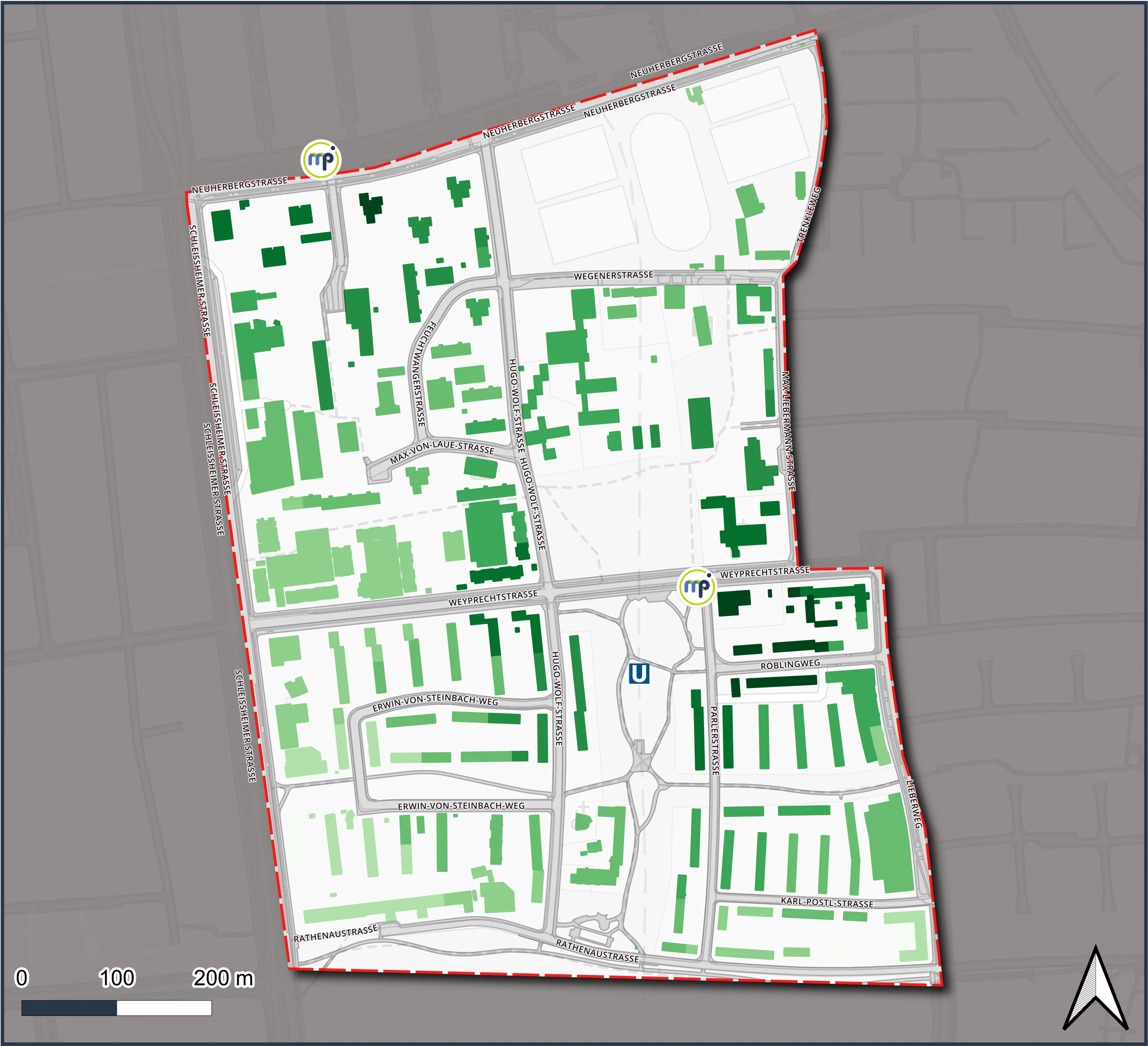
An integrated, innovative shared mobility concept for Harthof, a Munich district, commissioned by the Landeshauptstadt München. The initiative is part of the EU-funded ASCEND ("Accelerate Positive Clean Energy Districts") programme, which aims to turn Harthof into a Positive Clean Energy District by 2027. Alongside energy and smart-city technologies, the project develops data-driven mobility solutions that integrate public and private shared mobility offerings.
The project is delivered by a consortium of stattbau münchen GmbH (sustainable urban development), Plan4Better GmbH (data-driven mobility planning and the GOAT platform) and the Good Mobility Council (shared mobility integration). I carried out the accessibility and parking-demand analysis and produced the cartography, working alongside colleagues at Plan4Better and the wider consortium.
Client: Landeshauptstadt München · Period: 2024–2025
View on Plan4Better ↗Workflow
Follow the process. Expand a step for the details.
01Fine-Grained Data Collection
Gathered accessibility, walkability, sociodemographic and land-use data from municipal sources, including digital twin data, as the foundation for the analysis.
02Accessibility to Mobility Points
Mapped walking-time accessibility to shared mobility points and daily-need destinations across Harthof, identifying where new mobility hubs would have the greatest reach.
03Usage & Parking Demand Analysis
Evaluated shared mobility rental data and public space use, and calculated data-driven parking demand based on local accessibility and sociodemographics.
04Scenario Modelling & Stakeholder Engagement
Modelled integration scenarios for mobility services and translated findings into workshops and dialogue formats with property managers, residents and the city.
Focus Areas
- Granular data collection on accessibility and walkability using municipal data sources
- Accessibility analysis of shared mobility services and daily-need destinations
- Shared mobility usage analysis, evaluating rental data and public space use
- Data-driven parking demand calculation based on local accessibility and sociodemographics
- Scenario modelling and recommendations for integrating mobility services
- Stakeholder engagement through workshops and dialogue formats
Goals & Outcomes
- A comprehensive shared mobility concept for Harthof, scalable to other neighbourhoods
- Integration of private mobility services from property managers, complemented by public offerings at mobility hubs
- Collected data made available for digital twin integration, supporting long-term concept development
- Stronger collaboration between private and public actors, with the local community engaged throughout
Tools & Technologies
- GOAT (Plan4Better) — accessibility analysis, parking demand modelling and cartographic output
- Municipal data sources, including digital twin, sociodemographic and land-use data
- Shared mobility rental and public-space usage data
Outcome
Delivered a data-driven, participatory shared mobility concept for Harthof that integrates public and private mobility offerings at dedicated hubs, provides a transferable model for other Munich neighbourhoods, and feeds collected data into the district's digital twin for long-term planning.