Overview
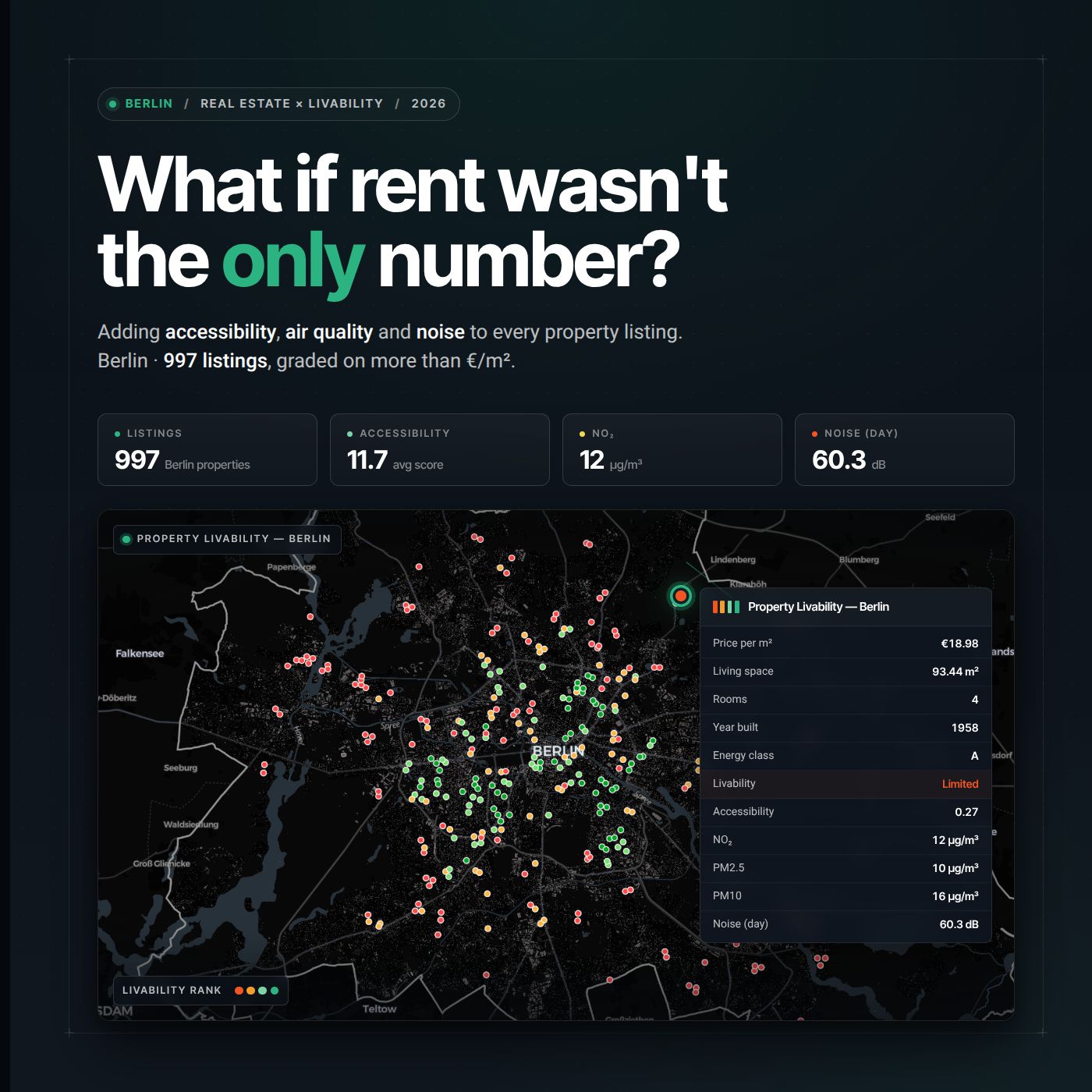
A GOAT-based experiment that goes beyond the standard rental listing data — rent, size, rooms, energy class — to answer what living in a place will actually feel like. Around 1,000 synthetic Berlin rental listings were enriched with two additional layers: a walkability-based accessibility score and environmental quality data, giving a more complete picture of each location's liveability.
The live interactive map lets you click any listing and immediately see not just the price, but how walkable the surroundings are and what the air and noise conditions look like.
Methodology
Accessibility Score — Gravity Model
Computed a 15-minute walking catchment for each listing using GOAT's real pedestrian network. A gravity model weighted six POI categories by their importance to daily life:
- Shopping (supermarkets, bakeries, groceries) — 25%
- Gastronomy (restaurants, cafés, bars) — 20%
- Health (pharmacies, GPs, hospitals) — 20%
- Services (post, bank, ATMs) — 15%
- Schools — 10%
- Kitas (daycare) — 10%
Environmental Data Layer
Added official environmental indicators per listing from Berlin's open data sources: NO₂, PM10 and PM2.5 concentrations from Berlin's air quality grid, and 24-hour noise levels from the 2022 Berlin noise maps.
Interactive Map — GOAT
Combined both layers into a single interactive GOAT map. Each listing is clickable and shows its accessibility score alongside environmental indicators — making the full liveability context visible at a glance.
Tools & Technologies
- GOAT (Plan4Better) — gravity model accessibility, pedestrian network, interactive map
- Berlin official air quality grid — NO₂, PM10, PM2.5
- Berlin noise maps 2022 — 24h noise levels
- OpenStreetMap — POI data for accessibility scoring
- Claude — visual design and map layout
Outcome
Demonstrated how open geodata and network-based accessibility tools can move rental decision-making beyond price and size — surfacing the environmental and walkability context that listings typically omit. A practical example of how GOAT can be applied outside traditional planning workflows.